

I’ll never forget the first time an NPC in a game actually surprised me with a response that felt unscripted. It was during a playthrough of a modern RPG where a shopkeeper remembered not just that I’d been rude to them three sessions ago, but brought it up in a way that felt genuinely petty. That small moment of continuity made the entire world feel more alive than any graphics upgrade ever could.
Social interaction has always been the backbone of memorable gaming experiences, but for decades, it followed predictable patterns. You’d get the same three dialogue options, NPCs would repeat identical lines, and choice was mostly an illusion. Today, though, we’re seeing something different emerge in simulation systems that create the feeling of genuine social dynamics, even when you’re the only human player in the room.
From Scripted Lines to Simulated Relationships
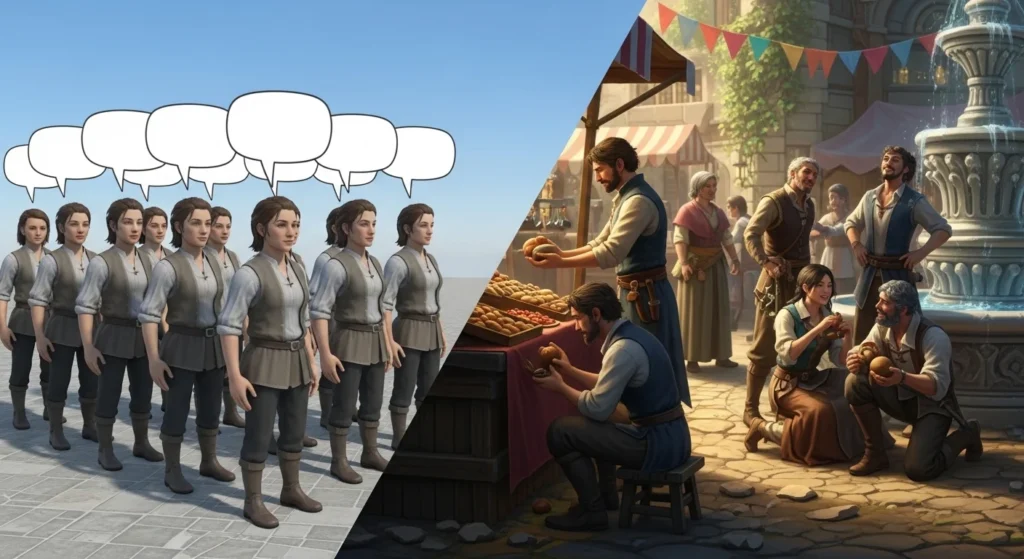
The evolution here has been gradual but fascinating. Early games gave us basic branching dialogue trees pick option A, get response B. The original Mass Effect trilogy became beloved partly because it expanded these trees into actual relationship systems where characters would remember your choices across entire games. But even that was fundamentally scripted. Every response was written by hand, every relationship path mapped out in advance.
What’s changed in recent years is the shift toward simulation rather than pure scripting. Instead of writing every possible conversation, developers now create systems that model how characters should behave based on their personality traits, memories, current emotional states, and relationships with the player.
Take the Sims series as a straightforward example. Those characters aren’t following predetermined storylines; they’re operating on relationship meters, need states, and personality variables that interact in semi unpredictable ways. Your Sim might autonomously start a fight with their roommate because their hygiene stat is low and their mean trait is high. It’s not sophisticated by modern standards, but it demonstrates the principle: simulate the underlying systems, and social behavior emerges.
How Modern Games Actually Pull This Off

From what I’ve observed working with game development communities and digging into technical documentation, most contemporary social simulations break down into several layered systems working together.
First, there’s the knowledge base: what does this character know? More advanced games now track individual NPC memories. In Red Dead Redemption 2, townspeople will recognize you based on your previous actions, your clothing, or even how long it’s been since they saw you. This isn’t magic; it’s a database that logs interactions and queries them during encounters.
Second, there’s emotional modeling. Characters maintain internal states that affect behavior. The nemesis system in Middle earth: Shadow of Mordor became famous for this: orcs would remember if you killed their blood brother, escaped from them, or scarred them in battle. Their personality would literally change. A cowardly orc who managed to kill you might become arrogant. These weren’t cutscenes; they were procedurally generated based on relationship variables.
Third, we have goal oriented behavior. Rather than scripting exact actions, developers define goals and let characters figure out how to achieve them. In The Elder Scrolls games, NPCs have daily schedules and needs. They’ll go to the market because they need food, not because their script says to walk to the market at 2 pm.
The newest frontier involves what I’d call contextual dialogue generation. Games like AI Dungeon experimented with this heavily, though with mixed results. More recently, Potionomics and similar titles use systems that assemble dialogue from modular components based on the context of the NPC’s mood, recent events, time of day, and your relationship history. It’s not entirely freeform, but it creates variety that would be impossible to handwrite.
When It Works, It Really Works

I’ve seen players form genuine emotional attachments to characters in games with strong social simulation. The farming sim Stardew Valley uses relatively simple mechanics, gift giving, repeated conversations, heart events at relationship milestones, but players talk about these characters like real friends.
The reason this works isn’t complexity; it’s consistency and consequence. When a game character remembers what you did, reacts proportionally, and changes over time, your brain starts treating the interaction as semi real. The simulation doesn’t need to be perfect; it needs to be believable within the game’s context.
Crusader Kings III takes this to strategic extremes. Every character in your medieval dynasty has traits, opinions, secrets, and schemes. Your son might hate you because you executed his mother. Your spymaster might be secretly in love with your wife. None of this is scripted; it emerges from simulation systems interacting. Players end up with stories that are uniquely theirs.
The Rough Edges Nobody Talks About
Of course, this technology is far from seamless. I’ve encountered plenty of immersion-breaking moments, such as characters who forget critical plot points, emotional responses that don’t match the situation, or relationship systems that feel exploitable once you understand the underlying math.
There’s also the resource problem. Sophisticated social simulation is expensive not just in development time, but in processing power and memory. Even big budget games have to make compromises. Background NPCs get simpler systems than main characters. Conversations might feel dynamic until you exhaust the variations, and patterns start repeating.
Ethical questions are emerging, too. As these systems become more sophisticated, there’s legitimate discussion about parasocial relationships with game characters, especially in games designed around romance or companionship. When a simulation feels too real, it can affect how players process actual human relationships. I’ve read accounts from players who became genuinely distressed over rejecting a video game character, which shows both the power and potential concern of this technology.
What’s Actually on the Horizon
Based on industry conferences and developer interviews I’ve followed, the next evolution seems focused on persistence and believability at scale. Imagine open world games where every NPC has a working memory, where your reputation actually spreads through social networks of characters, and where consequences of social choices ripple outward for hours of gameplay.
Some developers are exploring what they call social physics, modeling how information, rumors, and relationships spread through communities using principles similar to physical simulation. Instead of hand-crafting how a town reacts to your heroism, the system would simulate gossip spread, reputation changes, and emergent social dynamics.
The technical foundation is largely there. The challenge now is design creating systems that produce interesting, varied social experiences without overwhelming players or breaking narrative coherence.
Making Peace with Simulation
Here’s what I’ve learned from years of playing and analyzing these games: perfect simulation isn’t the goal, and honestly, it might not even be desirable. What matters is creating enough responsiveness and memory to make players feel their social choices have weight.
The best implementations I’ve experienced blend scripted storytelling with simulated dynamics. Key narrative moments are carefully written, but the space between them is filled with systems that react, remember, and evolve. That combination creates something that feels more alive than either approach alone.
As someone who remembers when NPC dialogue was literally or Welcome to Corneria, watching townspeople now greet me differently based on what I’m wearing and who I helped last week feels like science fiction come to life. And we’re still in the early stages.
FAQs
What games have the best social interaction AI?
Red Dead Redemption 2, Crusader Kings III, The Sims 4, and Disco Elysium are frequently cited for sophisticated social systems, each excelling in different ways, from NPC memory to character personality modeling.
Do NPCs actually remember everything you do?
They remember what the game is programmed to track, which varies widely. Some games track dozens of interactions; others only flag major story choices. Memory systems are selective in managing technical limitations.
Can social AI in games replace multiplayer interaction?
Not entirely. AI can simulate social mechanics, but it lacks the genuine unpredictability and emotional depth of human players. It’s a different experience, not a replacement.
Is this technology used outside of games?
Yes, similar systems power chatbots, training simulations, and interactive storytelling applications. Game development often pioneers techniques later used in other fields.
Will social AI make games feel less scripted?
In some ways, yes, but the best games still combine scripting with simulation. Pure simulation can feel aimless; pure scripting feels rigid. The sweet spot is a hybrid design.