
I still remember watching a demo at GDC a few years back where a virtual character caught itself mid stumble, adjusted its weight distribution, and kept walking without any pre programmed animation. That moment crystallized something for me: we had crossed a threshold in how machines understand and replicate human motion.
Having spent over a decade working in game development and motion capture, I’ve witnessed the evolution from stiff, robotic animations to movement that genuinely feels alive. AI realistic movement simulation isn’t just a technical achievement, it’s reshaping entertainment, robotics, healthcare, and beyond.
What Exactly Is AI Movement Simulation?
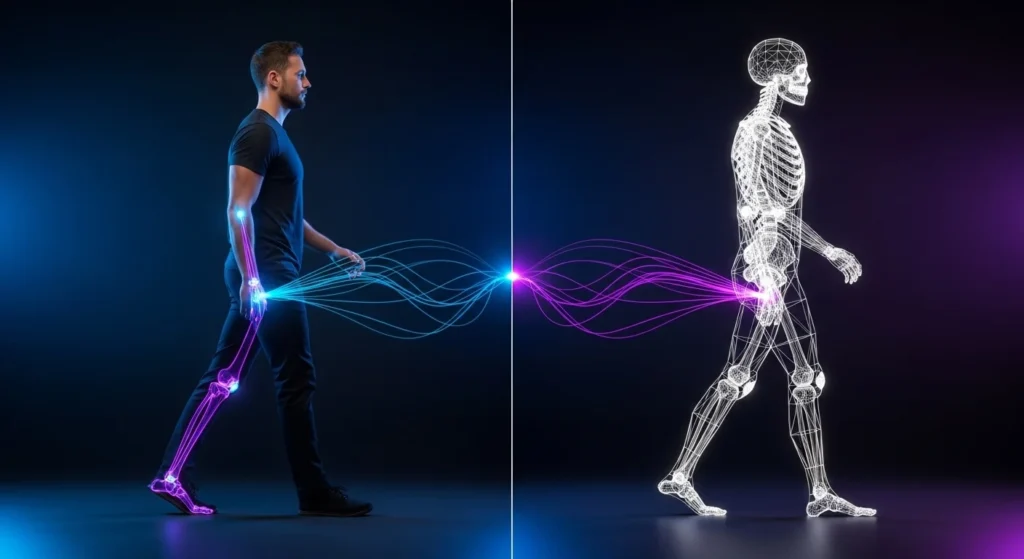
At its core, AI movement simulation uses machine learning algorithms to generate, predict, and control motion in virtual characters or physical robots. Unlike traditional animation, where artists manually craft every frame or rely on pre recorded motion capture data, AI driven systems can create dynamic, responsive movement in real time.
Think about how you walk. Your body constantly processes terrain information, adjusts for obstacles, compensates for wind, and maintains balance all without conscious thought. Replicating this in digital form has been one of computer science’s most persistent challenges.
Modern AI movement simulation tackles this through neural networks trained on massive datasets of human motion. These systems learn the underlying physics and biomechanics that govern how we move, rather than simply copying specific animations.
The Technology Behind Natural Motion
Several approaches power today’s movement simulation systems. Physics based character animation combines deep reinforcement learning with rigid body dynamics. Characters learn to move by receiving rewards for achieving goals, such as standing upright, reaching a destination, or performing specific tasks.
DeepMind’s work on simulated humanoid locomotion demonstrated this beautifully. Their virtual figures learned to walk, run, and navigate obstacles purely through trial and error, developing surprisingly natural gaits without any motion capture reference.
Motion matching represents another breakthrough. This technique maintains a database of motion capture clips and uses machine learning to seamlessly blend between them based on player input or environmental conditions. Ubisoft pioneered this approach with impressive results in their recent titles.
Generative adversarial networks (GANs) have also entered the movement space. By training discriminator networks to distinguish real human motion from synthetic movement, these systems push generator networks toward increasingly realistic output.
Real World Applications That Matter
Gaming and Interactive Entertainment
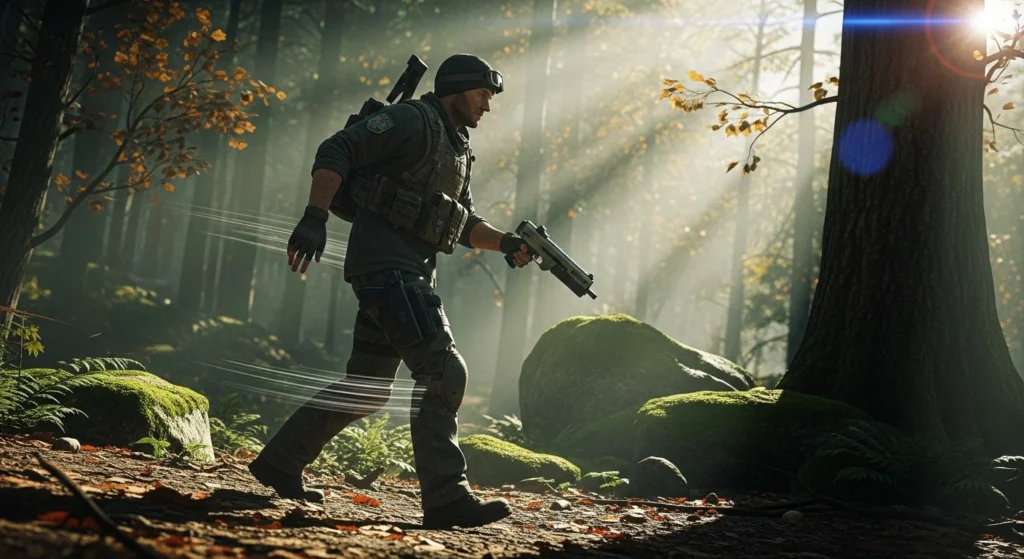
The gaming industry has been the most visible beneficiary. Gone are the days when characters had three walking animations that looped endlessly. Modern games feature protagonists who lean into turns, shift weight when carrying heavy objects, and respond to terrain with believable adjustments.
I worked on a project last year where we implemented neural network driven NPC movement. The difference in player feedback was remarkable. People described characters as “feeling present” without being able to articulate exactly why.
Film and Visual Effects
Major studios increasingly rely on AI simulation to handle crowd scenes and background characters. Creating thousands of individually animated extras would be prohibitively expensive. AI systems generate varied, naturalistic movement for virtual crowds that would take armies of animators to produce manually.
Robotics and Prosthetics
Boston Dynamics’ robots showcase practical applications of movement simulation research. Their machines navigate uneven terrain, recover from pushes, and adapt to unexpected conditions using principles derived from AI motion research.
Perhaps more meaningful are advances in prosthetics. AI driven limbs that predict user intent and generate natural movement patterns are improving lives. Research from MIT’s Biomechatronics group demonstrates prosthetic legs that adapt their gait in real time based on terrain and user behavior.
Healthcare and Rehabilitation
Physical therapists use movement simulation to analyze patient motion and design targeted interventions. AI systems can identify subtle abnormalities in gait or posture that human observers might miss, enabling earlier intervention for conditions like Parkinson’s disease.
Challenges and Honest Limitations
Despite impressive progress, significant hurdles remain. The “uncanny valley” still presents problems almost realistic movement can feel more disturbing than obviously artificial motion.
Computational demands remain substantial. Real time physics simulation with neural network inference requires serious processing power. Mobile and lower end platforms struggle to run sophisticated movement AI.
Training data presents another bottleneck. Creating diverse, high quality motion capture datasets is expensive and time consuming. Systems trained primarily on data from certain demographics may perform poorly when simulating different body types or movement patterns.
There’s also the question of edge cases. AI systems sometimes produce plausible looking movement that violates physical laws or human anatomy in subtle ways. These failures can break immersion instantly.
Where We’re Heading
The trajectory points toward even more impressive capabilities. Foundation models for movement analogous to large language models for text could enable systems that understand motion at a fundamental level and generalize across tasks.
Integration with computer vision will allow real-time adaptation to real world environments. Imagine virtual characters that see and respond to your actual living room as you play.
The combination of movement simulation with emotional AI opens fascinating possibilities. Characters might move in ways that convey specific emotional states, adapting their body language to narrative context without explicit direction.
Ethical Considerations Worth Noting
As someone who’s worked extensively with motion capture performers, I think about the implications for human artists. Will AI simulation eliminate jobs, or will it free artists to focus on creative decisions rather than technical execution?
Questions about consent and likeness rights also emerge. If AI can replicate a performer’s movement style, who owns that digital signature?
These conversations need to happen alongside technical development, not as an afterthought.
Frequently Asked Questions
What software is commonly used for AI movement simulation?
Unity ML Agents, NVIDIA Omniverse, and custom engines using PyTorch or TensorFlow are popular choices among developers.
How long does it take to train an AI movement model?
Training time varies dramatically simple locomotion might require days, while complex multi-action systems can take weeks on powerful hardware.
Can AI movement simulation work in real time?
Yes, modern implementations achieve real time performance, though computational requirements scale with complexity.
Is motion capture still necessary with AI simulation?
Motion capture remains valuable for training data and achieving specific performances, but AI reduces dependence on it for general movement.
What industries benefit most from this technology?
Gaming, film production, robotics, healthcare rehabilitation, and autonomous vehicle development see the most practical applications currently.