
When I first started working with vehicle simulations back in 2015, we spent countless hours manually tuning suspension parameters, tire grip curves, and weight transfer calculations. Every tweak meant recompiling code, testing, and praying the car didn’t flip over at the first corner. Fast forward to today, and the landscape has changed dramatically. AI driven vehicle physics systems have fundamentally transformed how we approach vehicle behavior, whether in gaming, automotive testing, or autonomous driving development.
Understanding the Basics
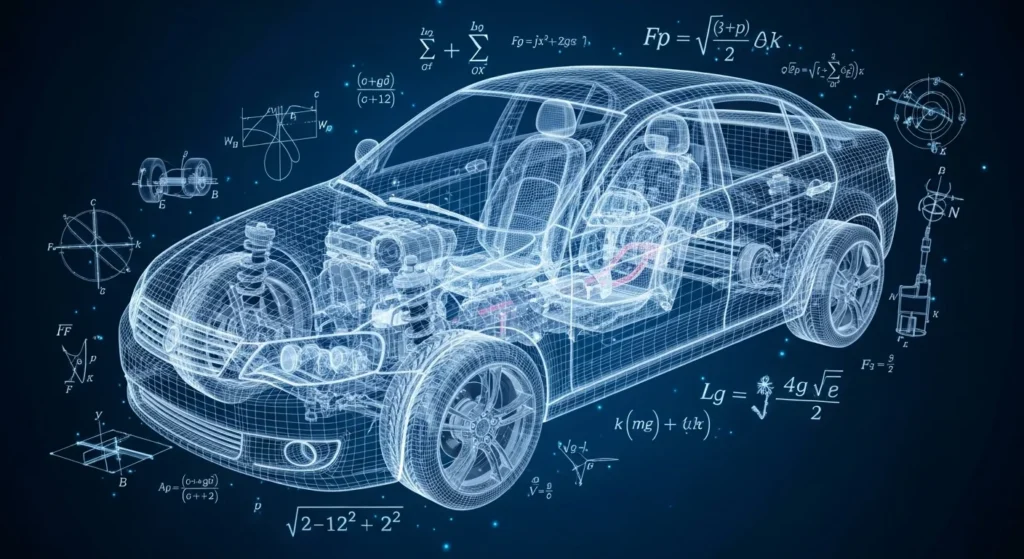
At its core, a vehicle physics system governs how a car, truck, motorcycle, or any wheeled vehicle behaves in a simulated environment. Traditional systems rely on predetermined mathematical models think rigid body dynamics, tire friction formulas like Pacejka’s Magic Formula, and spring damper calculations for suspension.
The problem? Reality is messy. Tire behavior changes with temperature, road surfaces vary wildly, and driver inputs are unpredictable. Hardcoded physics engines struggle to capture this complexity without becoming computational nightmares.
This is where intelligent systems enter the picture. By learning from vast datasets of real vehicle telemetry, these systems can predict and replicate behaviors that would take engineers months to manually program.
How Modern Systems Actually Work
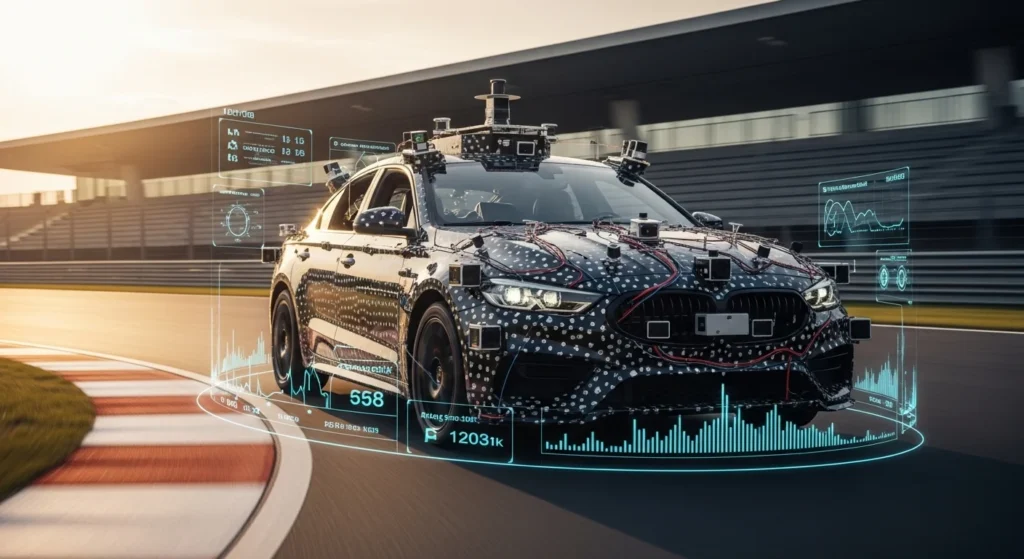
I’ve had the opportunity to collaborate with teams implementing machine learning approaches in racing simulators, and the methodology is fascinating. Rather than defining every parameter explicitly, the system trains on actual vehicle data acceleration patterns, braking distances, cornering forces, weight shifts, and even audio feedback from engine stress.
The neural networks identify patterns humans might miss. For instance, how a specific tire compound behaves differently at 45 degrees ambient temperature versus 70 degrees, or how wind resistance impacts stability at various speeds and yaw angles.
One project I consulted on involved training models using data from professional test drivers. We mounted dozens of sensors on actual vehicles, captured hours of driving across different conditions, and fed this information into the learning pipeline. The resulting physics model replicated real world handling with uncanny accuracy something our manually tuned system never achieved despite years of refinement.
Real World Applications Beyond Gaming
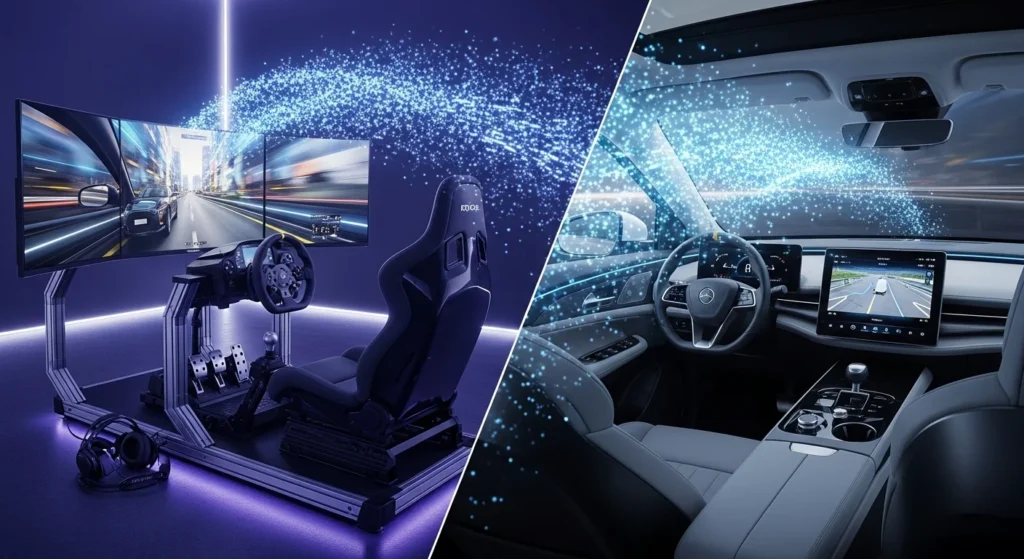
While video games like Forza Motorsport and Gran Turismo have popularized realistic vehicle physics, the applications extend far beyond entertainment.
Autonomous Vehicle Development:
Companies developing self driving cars use these systems extensively. Testing real vehicles in every conceivable scenario would be impossibly expensive and dangerous. Instead, intelligent physics simulations create millions of edge cases, wet roads, sudden tire blowouts, and pedestrians darting into traffic, allowing autonomous systems to train in virtual environments that behave like the real world.
Automotive Design:
Manufacturers now prototype vehicles digitally before building physical models. Engineers can test how theoretical suspension geometries perform, how weight distribution affects handling, and how aerodynamic changes impact stability. BMW, Mercedes, and Toyota have integrated these approaches into their development pipelines, reducing prototyping costs significantly.
Driver Training:
Professional racing teams and commercial driving schools use realistic simulations for training. When the physics feel authentic, drivers develop muscle memory and reflexes that transfer to actual vehicles. I’ve spoken with racing instructors who confirm that students trained on high-fidelity simulators adapt faster during track sessions.
The Technical Challenges Nobody Talks About
It’s not all smooth driving, though. Several significant hurdles remain in this field.
Data Quality:
These systems are only as good as their training data. Garbage in, garbage out applies strongly here. Capturing accurate telemetry requires expensive equipment and meticulous methodology. I’ve seen projects derailed because sensor calibration drifted mid session, corrupting entire datasets.
Computational Demands:
Running complex neural networks alongside real time physics simulation taxes hardware considerably. For gaming applications, especially, balancing visual fidelity with physics accuracy within frame rate budgets requires careful optimization. Some systems offload calculations to dedicated hardware or use simplified inference models during runtime.
Edge Cases:
Despite massive training datasets, unusual situations still cause problems. What happens when a vehicle drives over unusual terrain not represented in training data? Or when two rare conditions combine unexpectedly? The system might produce unrealistic results because it’s extrapolating beyond its knowledge base.
Validation:
How do you prove your simulated vehicle behaves like the real thing? This validation problem keeps engineers up at night. Subjective feel matters enormously; experienced drivers notice subtle wrongness that metrics might miss.
Where Industry Is Heading
The convergence of improved sensor technology, more powerful computing, and refined learning architectures points toward increasingly sophisticated systems. Several trends seem clear from my perspective.
Hybrid approaches combining physics based foundations with learned behaviors show particular promise. Rather than replacing traditional physics entirely, intelligent systems enhance specific components tire modeling, aerodynamics, and surface interactions while maintaining predictable baseline behavior.
Real time adaptation is another frontier. Imagine systems that continuously learn from player or driver inputs, adjusting physics responses to maintain challenge or optimize comfort. Some racing games already implement simplified versions of this concept.
Cross platform standardization may emerge as major players recognize efficiency gains from shared physics foundations. Currently, every studio and manufacturer builds proprietary solutions, duplicating effort industry wide.
Ethical Considerations
As these systems become more prevalent in safety critical applications, ethical questions arise. When autonomous vehicles train in simulated environments, how confident can we be that simulation fidelity translates to real world safety? Who bears responsibility when simulation limitations contribute to accidents?
These aren’t hypothetical concerns. Engineers I’ve worked with grapple with them constantly, implementing validation protocols and safety margins that account for simulation uncertainty.
Final Thoughts
Having watched this field evolve over nearly a decade, I’m genuinely excited about where vehicle physics systems are heading. The gap between simulation and reality continues shrinking. Young engineers entering the field have tools we couldn’t have imagined when I started.
That said, maintaining healthy skepticism serves everyone well. These systems are powerful tools, not magic solutions. Understanding their limitations matters as much as appreciating their capabilities.
Frequently Asked Questions
What makes AI driven vehicle physics different from traditional systems?
Traditional systems use fixed mathematical formulas, while intelligent approaches learn from real-world data to capture complex behaviors automatically.
Are these systems only used in video games?
No, they’re widely applied in autonomous vehicle development, automotive design, professional driver training, and research applications.
How accurate are these simulations compared to real vehicles?
High quality implementations achieve remarkable accuracy, though edge cases and unusual conditions can still produce unrealistic results.
What data is needed to train these systems?
Sensor data, including acceleration, steering angles, tire forces, suspension travel, speed, and environmental conditions from real vehicles.
Do these systems require powerful hardware to run?
Yes, particularly during training phases. Runtime requirements vary, but often need optimization for real-time applications.
Can these systems model any vehicle type?
Generally, yes, though each vehicle category requires appropriate training data and potentially specialized modeling approaches.