

I’ve spent the better part of a decade working at the intersection of game design and interactive storytelling, and nothing has fascinated me quite like watching procedural narratives evolve. What started as simple branching dialogue trees has become something far more ambitious, stories that generate themselves, adapt to player choices, and create genuinely unique experiences every single time.
Let me walk you through what’s actually happening in this space, because the reality is both more exciting and more nuanced than most headlines suggest.
What Exactly Is a Procedural Narrative?

At its core, a procedural narrative is a story that isn’t entirely written by a human author. Instead, it’s assembled, generated, or modified through algorithms and rule based systems. Think of it like jazz improvisation, there’s a structure, a key, maybe a melody, but the performance is different every night.
Traditional games give you a fixed story. You play through it, maybe make a few choices that branch the plot, but ultimately, you’re walking a path someone already carved. Procedural narratives throw that model out the window. The system itself becomes a co author.
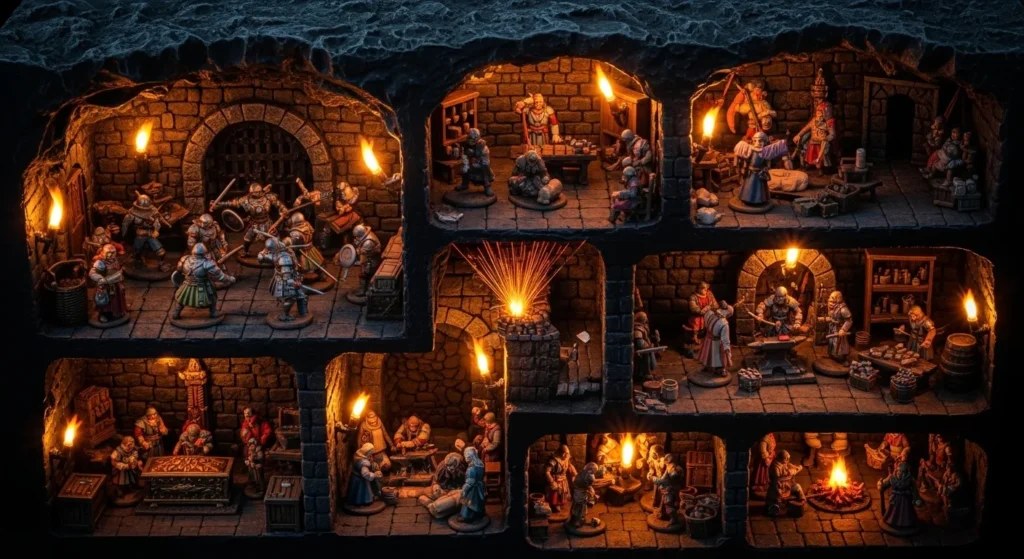
Games like Dwarf Fortress pioneered this years ago. Every fortress generates its own history, characters, rivalries, and tragedies. I once watched a dwarf go insane because a specific artifact couldn’t be crafted due to a missing material, and that created a cascading series of events that felt genuinely tragic. Nobody wrote that story. It emerged from systems interacting with each other.
The Role of AI in Shaping Dynamic Stories
Here’s where things get really interesting. Modern AI, particularly large language models and machine learning systems, has dramatically expanded what’s possible with procedural storytelling.
Earlier procedural systems relied on rigid rules. If X happens, then Y follows. It worked, but it felt mechanical. You could sense the gears turning behind the curtain.
AI changes the game by introducing flexibility and context awareness. Instead of following a strict decision tree, an AI driven narrative system can evaluate the emotional tone of a scene, consider a player’s past behavior, and generate dialogue or plot developments that feel organic.
AI Dungeon was one of the first widely accessible examples. It used language generation to create open-ended text adventures where literally anything could happen. Was it perfect? Absolutely not. Stories frequently went off the rails in bizarre ways. But it demonstrated something powerful that AI could improvise a narrative in real time.
More refined implementations have followed. Studios are now building AI systems that manage NPCs non player characters with their own goals, memories, and emotional states. These characters don’t just react to the player; they live their own lives within the game world, creating story threads that weave together unpredictably.
Real-World Applications Beyond Gaming
Procedural narratives aren’t limited to video games, and that’s something people often overlook.
Interactive fiction and education have embraced these techniques. Imagine a medical training simulation where the patient’s history, symptoms, and responses are procedurally generated, forcing students to think on their feet rather than memorize scripted scenarios. Several universities are already experimenting with this approach.
Film and television are exploring procedural storytelling concepts, too. While we’re not yet watching AI generated movies, and honestly, I’m not sure we should be, writers’ rooms are using AI tools to brainstorm plot variations, test narrative logic, and explore “what if” scenarios more efficiently.
Marketing and brand storytelling represent another frontier. Companies are creating personalized narrative experiences where the story adapts based on customer data, their preferences, browsing history, or even time of day. It’s subtle, but it’s a procedural narrative at work.
The Creative Tension: Authors vs. Algorithms
This is something I’ve debated with fellow writers and designers more times than I can count. There’s a legitimate concern that procedural narratives undermine authorial intent. When a machine generates the story, who’s really telling it?
My honest take? It’s a collaboration. The best procedural narrative systems don’t eliminate human creativity, they amplify it. A designer sets the rules, defines the emotional boundaries, and creates the world’s logic. The AI operates within those constraints to produce variations the designer never could have written alone.
Think of it like architecture versus nature. An architect designs a garden’s layout, selects the plants, and plans the pathways. But the garden grows on its own. Wind scatters seeds unexpectedly. Vines climb in directions nobody planned. That’s where the beauty lives in the space between intention and emergence.
That said, there are real limitations. AI generated narratives can feel shallow. They sometimes lack thematic coherence. A human author builds toward meaning deliberately. Procedural systems can stumble into profundity, but they can just as easily produce narrative nonsense.
Ethical Considerations Worth Discussing
We can’t talk about AI driven narratives without addressing some uncomfortable questions.
Bias in storytelling is a significant concern. If an AI system learns from existing stories, it inherits their biases, racial stereotypes, gender assumptions, and cultural blind spots. Without careful oversight, procedural narratives can perpetuate harmful patterns while appearing neutral.
Player manipulation is another issue. When a system understands your emotional responses and tailors stories accordingly, where’s the line between engagement and exploitation? Particularly with younger audiences, this deserves serious scrutiny.
Creative labor matters too. If AI can generate stories procedurally, what happens to writers? I don’t think writers become obsolete; if anything, the demand for skilled narrative designers who can build these systems increases. But the nature of the work changes, and the industry needs to reckon with that honestly.
Where This Is All Heading
We’re still in the early days, genuinely. The procedural narratives we have today will look primitive in five years. Systems are getting better at maintaining long-term narrative coherence, understanding character psychology, and creating emotionally resonant moments without human scripting.
The dream that I share is a story that knows you. One that adapts not just to your choices but to your personality, your mood, your history with the medium. A narrative that surprises even its creators.
We’re not there yet. But we’re closer than most people realize.
Frequently Asked Questions
What is a procedural narrative?
It’s a story generated or modified by algorithms rather than being entirely pre written, allowing for unique experiences each time.
How does AI improve procedural storytelling?
AI adds flexibility, context awareness, and natural language capabilities, making generated stories feel more organic and responsive to player actions.
Can AI replace human writers in storytelling?
Not really. AI works best as a collaborative tool that extends human creativity rather than replacing the intentionality and thematic depth human authors provide.
What games use procedural narratives?
Notable examples include Dwarf Fortress, Rimworld, AI Dungeon, and Middle-earth: Shadow of Mordor with its Nemesis System.
Are there ethical concerns with AI driven narratives?
Yes, including inherited biases from training data, potential player manipulation, and impacts on creative labor in the writing industry.
Is procedural narrative only used in gaming?
No. It’s also applied in education, training simulations, interactive fiction, marketing, and experimental film and media projects.