
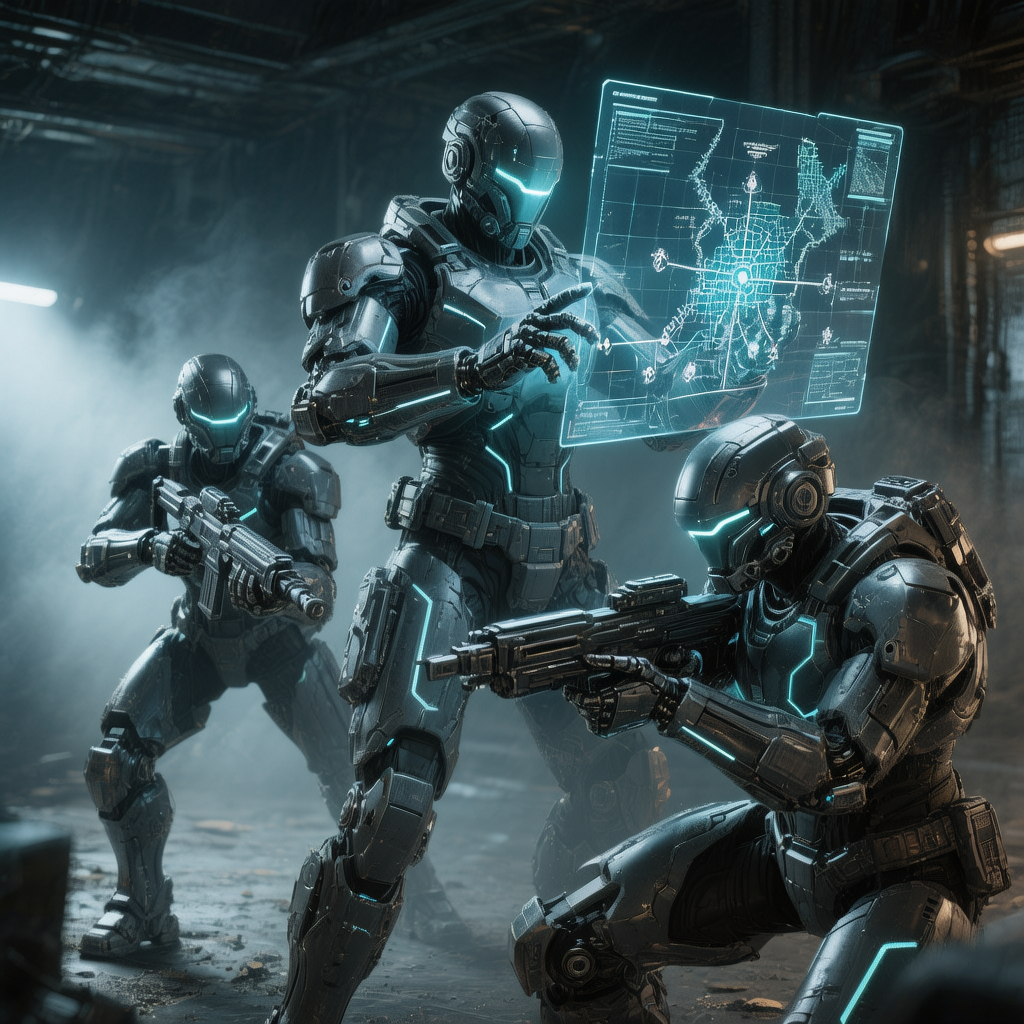
The first time I truly noticed intelligent enemy coordination, I was pinned down in a warehouse playing Ghost Recon: Wildlands. Two enemies suppressed my position with steady fire while a third circled around through a side entrance I’d completely forgotten about. When the flanker finally took me down, I wasn’t frustrated I was impressed. These weren’t mindless targets. They were operating as a team.
That experience fundamentally changed how I evaluate game combat. Intelligent enemy coordination represents one of the most important yet underappreciated aspects of game design. When done well, it transforms repetitive shooting galleries into tense, tactical encounters that demand genuine thought and adaptation.
What Makes Enemy Coordination “Intelligent”?
At its simplest, intelligent enemy coordination means AI-controlled opponents communicate, share information, and execute complementary actions to achieve shared goals. Rather than operating as isolated units following individual scripts, coordinated enemies function as cohesive groups.
Consider the difference between early shooter enemies and modern implementations. Classic Doom demons charged directly at players without any awareness of each other. Compare that to The Last of Us, where human enemies call out your position, coordinate search patterns, and adjust tactics based on teammate status.
The gap isn’t just technical sophistication it’s an entirely different design philosophy. One treats enemies as obstacles; the other treats them as opposing forces with their own tactical awareness.
The Building Blocks of Coordinated Behavior
Several interconnected systems enable enemies to work together effectively:
Communication Networks form the foundation. Enemies need mechanisms to share information about player location, tactical status, and intended actions. Some games implement this through actual voice callouts that players can hear, adding realism while providing useful gameplay information.
Role Assignment distributes responsibilities among group members. Rather than every enemy attempting identical behaviors, intelligent systems designate specific roles suppressor, flanker, grenadier, medic. This creates diverse threats that require varied responses.
Spatial Awareness helps enemies understand their positions relative to teammates and threats. Good coordination systems prevent enemies from clustering uselessly or blocking each other’s firing lines. They maintain appropriate spacing and seek complementary positions.
State Synchronization ensures enemies respond appropriately to changing circumstances. When one enemy spots you, relevant teammates should receive that information. When a leader falls, others should react accordingly.
I’ve spent considerable time analyzing how games implement these systems, and the sophistication varies dramatically across titles.
Standout Examples of Coordinated Enemies
Certain games deserve recognition for exceptional coordination implementation:
F.E.A.R. remains legendary among developers despite its age. Replica soldiers would verbally coordinate tactics, establish suppressing fire, request grenades, and execute flanking maneuvers that felt genuinely intelligent. The developers achieved this through sophisticated squad communication systems that allowed emergent tactical behavior.
Halo Series demonstrated coordination at scale. Covenant forces operate with clear hierarchies Elites command Grunts, who panic and scatter when leadership falls. Watching Jackals establish shield walls while Elites maneuver for better positions showcases thoughtful group behavior design.
The Division 2 implemented faction specific coordination patterns. Hyenas attack chaotically but aggressively, while True Sons employ military tactics with proper fire team coordination. Black Tusk operatives use the most sophisticated coordination, including drone deployment and systematic room clearing.
Horizon Forbidden West showed that coordination extends beyond humanoid enemies. Machine creatures exhibit pack behavior, with smaller units harrying players while larger machines prepare devastating attacks. The coordination feels organic and animal-like rather than tactical.
The Design Challenge Nobody Talks About
Here’s something crucial that rarely gets discussed: coordinated enemies are incredibly difficult to balance.
When I’ve spoken with developers about this topic, they consistently highlight the tension between impressive AI and enjoyable gameplay. Perfectly coordinated enemies would annihilate most players. Real military tactics, executed flawlessly by opponents who don’t panic or make mistakes, create punishing experiences that few find fun.
The solution involves carefully calibrated imperfection. Smart developers insert delays between information sharing, limit coordination range, and include occasional poor decisions that give players opportunities. An enemy who always flanks perfectly teaches players nothing except frustration. One who usually flanks well but sometimes overextends creates learnable patterns and satisfying counter-play.
Difficulty settings often adjust coordination sophistication rather than simply adding health or damage. Lower difficulties might feature enemies who rarely communicate, while higher settings showcase full tactical coordination.
How Coordination Shapes Player Experience
Well-implemented enemy coordination fundamentally changes how players approach combat:
Positioning becomes critical. When enemies coordinate flanking attempts, players can’t simply find one good spot and shoot everything. They must remain mobile, aware of multiple threat vectors simultaneously.
Prioritization matters. Identifying and eliminating coordinators or specific roles (like suppressing enemies) can disrupt entire group tactics. Players learn to read enemy behavior and exploit weaknesses.
Stealth gains value. Undetected players prevent coordination from triggering. This creates meaningful incentives for careful approach and rewards patience.
Resource management intensifies. Coordinated pressure depletes ammunition, health items, and special abilities faster than fighting isolated enemies.
The psychological impact shouldn’t be underestimated either. Fighting coordinated enemies feels more intense and immersive. Victories feel earned rather than inevitable.
Current Limitations and Future Possibilities
Despite impressive progress, intelligent enemy coordination still faces constraints:
Computational overhead limits how many enemies can actively coordinate. Processing complex group behaviors for dozens of simultaneous actors strains system resources.
Debugging complexity multiplies exponentially with coordination systems. Emergent behaviors between coordinating units create unpredictable scenarios that quality assurance teams struggle to anticipate.
Player perception gaps sometimes undermine coordination efforts. Players may not recognize sophisticated behavior, interpreting genuine tactical decisions as random chance or cheating.
Looking ahead, improved processing power and refined techniques promise even more sophisticated coordination. Procedural role assignment based on situation analysis, dynamic formation adaptation, and learning systems that develop new coordination patterns during gameplay all represent exciting possibilities.
The Invisible Art
Intelligent enemy coordination represents game design at its most invisible and essential. When enemies work together seamlessly, players simply experience challenging, fair combat without recognizing the underlying systems making it possible.
Next time you find yourself genuinely outmaneuvered by game enemies flanked, suppressed, and systematically dismantled take a moment to appreciate the coordination happening behind the scenes. Those enemies are executing teamwork that took developers months or years to implement properly.
That warehouse flanking maneuver I mentioned earlier? It taught me more about good game design than a dozen technical articles. Sometimes the best lessons come from getting thoroughly beaten by opponents who actually earned it.
Frequently Asked Questions
What game has the best enemy coordination?
F.E.A.R. remains widely respected for groundbreaking coordination, while modern titles like The Last of Us Part II and The Division 2 showcase excellent contemporary implementations.
Do coordinated enemies cheat by knowing player location?
Well-designed systems limit enemy knowledge to what they could realistically observe. Information spreads through communication rather than instant awareness.
Why do some enemies seem coordinated but others don’t?
Different enemy types often have varying coordination capabilities by design, reflecting their intended challenge level and narrative roles.
Does enemy coordination make games harder?
Generally yes, but good design balances coordination with exploitable weaknesses and appropriate difficulty scaling.
Can players disrupt enemy coordination?
Many games reward eliminating leaders or communication-capable enemies, allowing players to deliberately break coordination systems through smart target prioritization.