
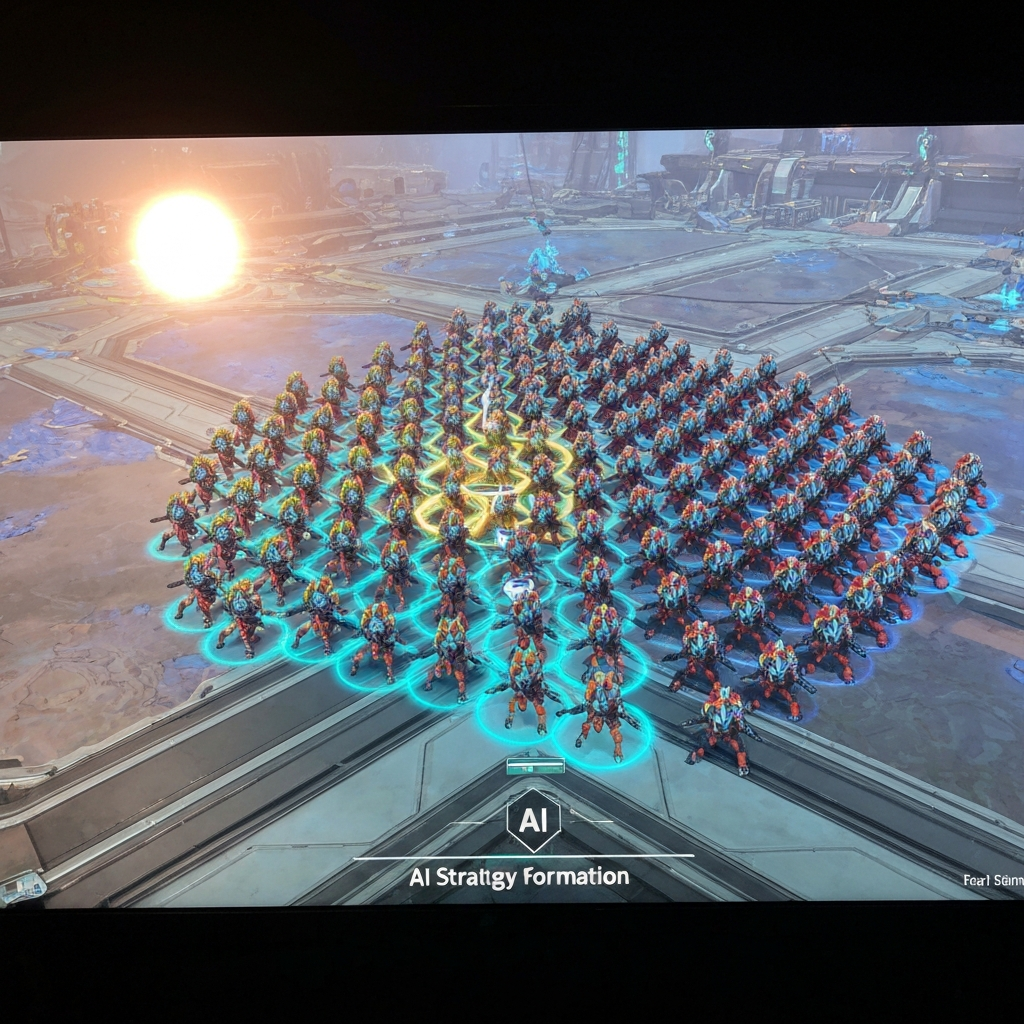
There’s a particular satisfaction in beating a genuinely clever opponent. Not one that simply reads your inputs or operates on pure reflex, but an adversary that actually formulates plans, adapts to setbacks, and tries to outthink you. That’s the magic of well-designed AI strategy formation, and after spending years dissecting how games pull this off, I’m still genuinely impressed by the sophistication hiding beneath the surface.
Strategy formation in game AI goes beyond moment-to-moment reactions. We’re talking about systems that establish goals, allocate resources, anticipate player actions, and adjust long-term plans when circumstances change. It’s the difference between playing checkers against a child and chess against someone who actually sees three moves ahead.
Understanding How Game AI Builds Strategies
At the fundamental level, AI strategy formation involves several interconnected processes that work together to create coherent, purposeful behavior.
Goal Prioritization sits at the top. Every AI system needs to understand what it’s trying to accomplish. In a real-time strategy game, this might mean balancing economic development against military expansion. In a sports simulation, it could involve weighing offensive aggression against defensive stability.
What makes this tricky is that goals constantly shift based on game state. An AI civilization that starts peacefully might pivot toward military strategy when threatened. A racing AI leading by ten seconds will prioritize different things than one desperately fighting for position.
State Evaluation gives AI the information necessary for good decisions. The system must accurately assess its current situation, available resources, opponent positions, and potential threats. Poor evaluation leads to disastrous strategies like building excessive defenses when aggressive expansion would win easily.
I’ve watched countless strategy games where AI opponents failed not because they couldn’t execute plans, but because they fundamentally misread situations. Getting evaluation right matters enormously.
The Architecture Behind Strategic Thinking
Several technical approaches power AI strategy formation in modern games:
Utility Systems assign numerical values to potential actions based on current circumstances. The AI continuously calculates which options offer the highest expected value and pursues those. This creates flexible, responsive behavior that adapts naturally to changing conditions.
Civilization games exemplify this approach beautifully. AI leaders evaluate whether building military units, constructing infrastructure, or pursuing diplomacy serves their current interests best. The calculations happen constantly, producing strategies that feel organic rather than scripted.
Hierarchical Task Networks break complex strategies into manageable subtasks. A high level goal like “conquer enemy territory” gets decomposed into securing supply lines, building appropriate forces, identifying weak points, and executing attacks. Each layer handles appropriate complexity levels.
Monte Carlo Tree Search revolutionized strategy games by allowing AI to simulate thousands of possible futures before committing to actions. Games like Go and sophisticated board game adaptations use this approach to evaluate moves that might not pay off for dozens of turns.
Case Studies Worth Examining
Certain games showcase exceptional strategy formation:
StarCraft II’s AI operates at remarkable sophistication levels. Higher difficulty settings feature opponents that scout effectively, respond to your unit compositions with appropriate counters, time attacks to exploit vulnerabilities, and manage economies efficiently. Playing against Elite AI genuinely teaches strategic concepts.
Football Manager simulates opposing managers who develop distinct tactical philosophies, adjust formations based on personnel, and make in match changes responding to scorelines. I’ve watched AI managers completely change approaches at halftime after my tactics exposed their weaknesses.
Total War: Warhammer demonstrates strategic planning across multiple scales. AI factions pursue territorial ambitions, form logical alliances, and respond to player actions with coordinated military and diplomatic strategies. They don’t always succeed, but their reasoning generally follows understandable logic.
Rimworld presents an interesting variant where AI “storytellers” strategically create challenges based on colony development. Rather than opposing the player directly, these systems formulate strategies for generating compelling narratives through carefully timed events.
The Human Factor in Strategic Design

Here’s something important that often gets overlooked: perfect strategic AI makes terrible games.
I learned this lesson watching developers playtest strategy titles. AI that always made optimal decisions crushed players mercilessly. Nobody enjoyed the experience. Strategic AI needs to be smart enough to challenge and teach, but flawed enough to remain beatable.
This creates fascinating design challenges. How do you build systems that form intelligent strategies while occasionally making the kind of mistakes human players make? The best implementations include intentional blind spots, delayed reactions to new information, and occasional overcommitment to failing plans.
These “mistakes” aren’t bugs they’re carefully calibrated features that make AI opponents feel human.
Current Limitations and Challenges
Strategy formation AI still struggles with several persistent issues:
Novel situations expose AI weaknesses. When players discover unexpected tactics or exploit unconventional strategies, AI often responds poorly. Human opponents adapt through reasoning; AI typically requires explicit programming for edge cases.
Long-term planning remains computationally expensive. Thinking ahead many moves requires evaluating enormous decision trees. Games compromise by limiting lookahead depth or simplifying evaluation criteria.
Coordination complexity multiplies in team scenarios. Getting multiple AI entities to form and execute coherent group strategies without extensive communication overhead presents ongoing challenges.
Transparency questions affect player experience. Should players understand why AI made particular strategic choices? Too much opacity feels random; too much transparency feels predictable.
Looking Forward
The future of AI strategy formation holds exciting possibilities. Machine learning approaches are beginning to produce opponents that genuinely learn from player behavior, though implementation remains limited in commercial releases.
Hybrid systems combining traditional programming with learned behaviors show promise. These approaches maintain reliability while incorporating adaptive elements that surprise players.
Procedural strategy generation could eventually create AI opponents with truly unique personalities and approaches, making every playthrough feel fresh.
Why This Matters
Good AI strategy formation elevates games from puzzles with solutions to genuine competitions requiring thought. When an AI opponent earns your respect when defeating them feels like an accomplishment rather than completing a checklist developers have achieved something special.
The invisible chess match happening behind every strategic game represents decades of research and refinement. Those digital opponents thinking several moves ahead deserve appreciation for making our victories meaningful.
Frequently Asked Questions
What’s the difference between tactics and strategy in game AI?
Strategy involves long-term planning and resource allocation, while tactics handle immediate combat and short-term decisions.
Do AI opponents in games actually plan ahead?
Yes, many modern games use lookahead algorithms that evaluate future game states before making decisions.
Why does AI sometimes make obviously bad strategic choices?
Often intentionally designed to maintain game balance and give players opportunities to exploit mistakes.
Which game genre has the most sophisticated strategic AI?
Turn-based strategy and 4X games typically feature the most complex strategy formation systems.
Can game AI truly adapt to individual player strategies?
Some games track player tendencies and adjust approaches, though genuine learning AI remains relatively uncommon in mainstream titles.