
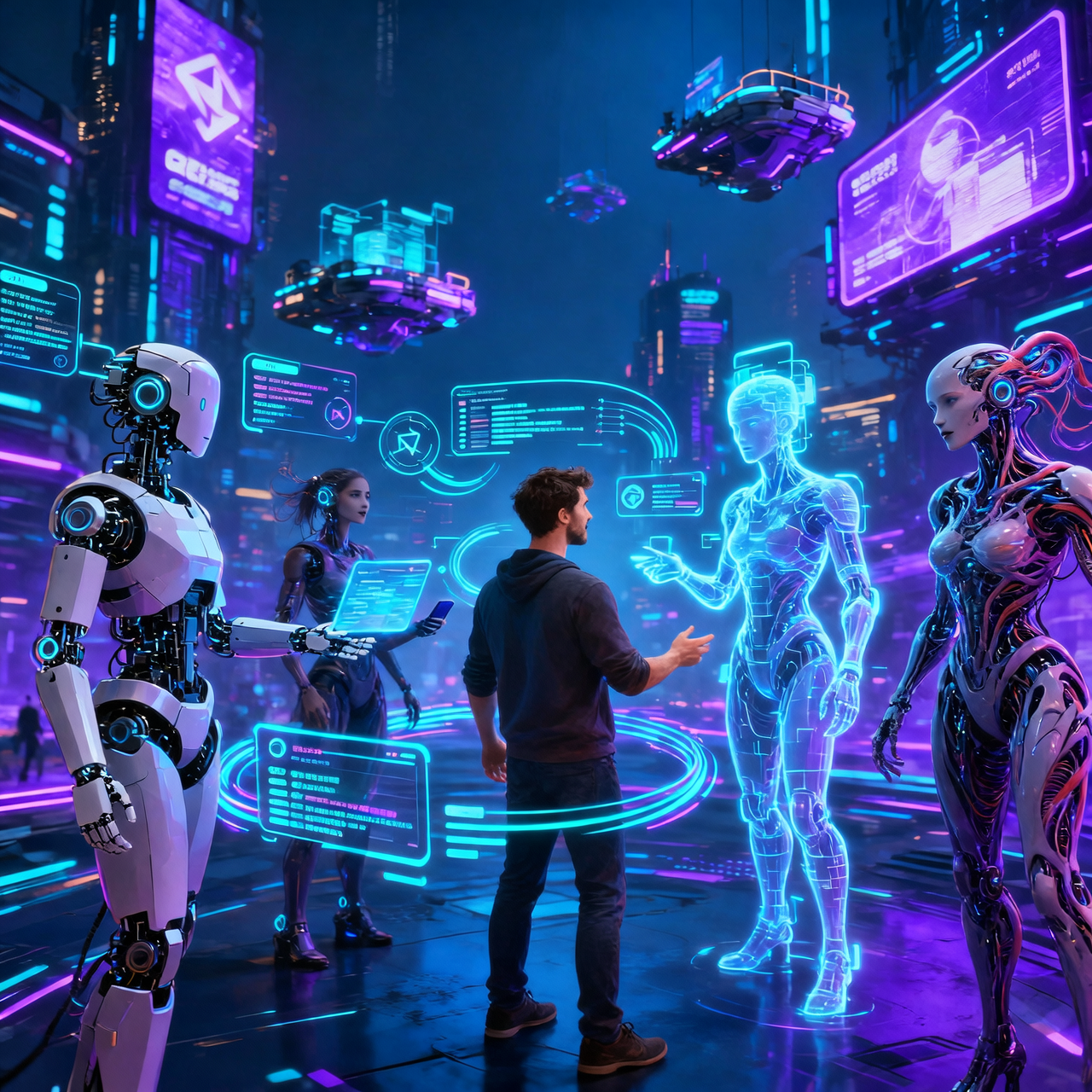
There’s a moment every gamer knows too well. You’re deep in an immersive RPG, exploring a medieval village, and you approach a blacksmith to ask about local rumors. He delivers the same three lines he’s said every single time you’ve walked past. The illusion shatters. You remember you’re playing a game.
That frustrating disconnect is exactly what developers have been battling for decades. And honestly, after spending countless hours testing various games over the years, I can tell you that AI powered NPCs represent one of the most significant shifts I’ve witnessed in interactive entertainment.
Beyond the Script: What Makes AI-Powered NPCs Different
Traditional NPCs operate on decision trees basically elaborate flowcharts where designers manually program every possible response. Ask about the weather, get Response A. Ask about quests, get Response B. It’s functional but painfully limited.
AI-powered NPCs flip this model entirely. Instead of scripted responses, these characters use language models and behavioral systems that generate contextual, dynamic reactions based on the situation, your history with them, and even their own simulated personality traits.
I remember playing an early demo featuring this technology last year. I asked an innkeeper about her family, then later mentioned bandits on the road. Twenty minutes later, when I returned, she asked if my journey had been safer. She remembered. She connected dots. That simple moment felt revolutionary.
The Technology Behind the Magic

Without getting too technical, AI NPCs typically combine several systems working together. Natural language processing allows them to understand player input that isn’t limited to predetermined dialogue options. Machine learning models help them generate appropriate responses while maintaining character consistency.
More sophisticated implementations add memory systems both short-term conversational context and long-term recall of previous interactions. Some include emotional modeling, where NPCs track their feelings toward players based on past behavior.
Inworld AI and Convai are two companies I’ve seen making significant strides here. Their platforms let developers create NPCs with defined backstories, personality parameters, and knowledge bases. The character stays consistent but responds dynamically to unpredictable player behavior.
Real Games, Real Implementation
Ubisoft made waves with their NEO NPC project, demonstrating non-scripted characters in their game environments. While still experimental, it showed major studios taking this seriously.
The indie space has been surprisingly active too. Games like “Vaudeville” and various narrative experiments on platforms like itch.io have pushed boundaries without the constraints of A development cycles. These smaller projects often reveal what’s truly possible when developers embrace the technology fully.
Nvidia’s Avatar Cloud Engine has also demonstrated impressive capabilities, powering NPCs that can hold genuinely unpredictable conversations while maintaining world appropriate knowledge boundaries. You can’t trick a medieval shopkeeper into discussing smartphones they simply won’t understand the concept.
Why This Actually Matters for Players
Beyond the novelty, AI NPCs fundamentally change gameplay possibilities. Mystery games become genuinely investigative when you can question suspects freely. RPGs gain depth when romantic interests remember your first awkward conversation. Even action games benefit when enemies coordinate, adapt, and occasionally try to negotiate.
The emergent storytelling potential excites me most. When NPCs can react authentically to player choices, stories become genuinely personal. Two players might have completely different relationships with the same character based on their interactions.
I’ve spoken with several developers working on these systems, and they consistently emphasize player agency. One described it as “moving from performing in our play to actually living in our world.”
The Honest Limitations
Let’s be realistic though we’re not there yet. Current AI NPCs can produce inconsistent responses, occasionally break character, or generate inappropriate content if not properly constrained. The computational requirements remain substantial, making implementation challenging for games with hundreds of characters.
There’s also the uncanny valley problem. Sometimes an NPC that’s almost perfectly responsive feels stranger than one obviously limited. Our brains expect consistency from beings that seem intelligent, and AI systems can violate those expectations in jarring ways.
Cost presents another barrier. Licensing AI platforms, processing cloud-based responses, and the development time required to properly integrate these systems adds significantly to budgets. Many studios remain hesitant about the investment.
Ethical Terrain Worth Considering
Player attachment to believable characters raises interesting questions. If NPCs can simulate emotional responses convincingly, do developers have responsibilities around that capability? Some players already form genuine emotional connections to well-written scripted characters. Dynamic AI amplifies this significantly.
Data privacy concerns exist too. Some AI NPC systems analyze player input to improve responses. What happens to those conversation logs? How might that information be used?
And there’s the voice acting question. If AI can generate dialogue dynamically, what happens to the performers who’ve brought characters to life for decades? The industry hasn’t fully grappled with these implications.
Looking Forward
The trajectory seems clear, even if the timeline remains uncertain. Within five years, I expect AI-powered NPCs to become standard in major releases, at least for key characters. The technology will likely remain complementary to scripted content rather than replacing it entirely—certain narrative moments simply require authored precision.
What genuinely thrills me is imagining games built from the ground up around these capabilities. Not retrofitting dynamic NPCs into traditional designs, but creating experiences impossible without them. Detective games where suspects can be interrogated infinitely. Fantasy worlds where every villager has genuine daily routines and opinions about events. Multiplayer experiences where AI characters bridge gaps between player sessions.
We’re witnessing the early chapters of gaming’s next major evolution. The NPCs of tomorrow won’t just populate our virtual worlds they’ll genuinely inhabit them.
Frequently Asked Questions
What exactly are AI-powered NPCs?
Non-player characters that use artificial intelligence to generate dynamic responses and behaviors rather than following pre-written scripts.
Which games currently feature AI NPCs?
Several experimental projects and indie games incorporate this technology, with major studios like Ubisoft actively developing implementations for future releases.
Do AI NPCs require internet connections?
Many current systems rely on cloud processing, though some developers are working on local solutions that run entirely on player hardware.
Will AI NPCs replace voice actors?
The industry is still navigating this question. Most developers currently envision AI complementing rather than replacing human performances.
Can AI NPCs remember previous conversations?
Yes, memory systems allow them to recall past interactions and reference them in future conversations.
Are AI NPCs available for all game genres?
While narrative-focused games benefit most, the technology applies across genres from shooters to simulations.